Hello again from 53.5° north latitude. Summer seems to have arrived but fall will be here later this week with temperatures forecasted to fall below freezing in a few days. Plus it is getting too dark to read in the car while the kids are at their various activities during the weeknights. Time to get out the winter bike.
Let’s get on with it, shall we? \
Podcast - Radiolab series on “G”
Radiolab is a great show, but I’m sure you know that already. Earlier this summer, they had a six-part series called G. G is the symbol for intelligence, and boy, would it be great if it was as easy to quantify and articulate a person’s intelligence as a one letter moniker might imply. The six episodes did a nice job of outlining how hard intelligence is to define, let alone quantify. Here are some highlights I took away from the series. (Links to the six episodes here - 1, 2, 3, 4, 5, 6)
- Best quote in the series comes from the first episode - “Good intentions are the Devil’s toilet paper.”
- From the second episode came the concept that intelligence is a colloquial word, and that it really is the “ability to navigate in the problem space”.
- The third episode was all about Einstein’s brain. Super interesting. Kinda weird.
- The fourth episode got into how a quantified value of intelligence has been used to support arguments for eugenics. Apparently eugenics comes from the Greek words for “good birth”, meaning we should figure out who is “good” and let them reproduce. Forced sterilizations ensue and that is just some terrifying stuff. The episode also introduced me to the Oliver Wendell Holmes US Supreme Court finding that “three generations of imbeciles is enough”. The first three episodes were all interesting; this one was pretty hard to digest.
- Next up in the fifth episode was a discussion on the burgeoning ability to analyze the genome to select for markers of high intelligence. Fertilizing eggs, analyze the outcomes, pick the best of the sample, discard the rest. I mentioned two weeks ago that I am reading “Homo Deus” and from that, I don’t think there is anyway we stop this from happening. I have more to say about Homo Deus below.
- Finally, episode six was nice and light with scientists and comedians debating the intelligence of non-human mammals. There was a fascinating discussion about how the sperm whale might be able to feel emotions in a way that we cannot understand. That begs the question of our ability to judge the intelligence of other animals if our physical limitations stop us from experiencing what they experience. Great stuff to sit back and think about. But not like a sperm whale would think about it, because, you know, we can’t think like them.
Reading Pile, aka Musings on What it Means to Have an Opinion:
I find it interesting how the reading pile organically seems to organize around themes. Earlier this year, the theme was around capitalism, captured by a half dozen or so posts referencing the topic. In the last few weeks, the themes that have surfaced are around humanism and disconnecting, I mentioned “Homo Deus” by Yuval Noah Harari above and quoted from it two weeks ago. I powered it through it on the weekend and came away with all sorts of conflicting thoughts. Are humans really the apex of life on Earth? Are we nothing more than algorithmic cogs in a machine to process information? If we admit that our human fallibility limits our ability to make the best choices, should we concede our decision-making to more advanced algorithms that are external from our bodies? In other words, should we allow some Internet behemoth to tell us what is best?
Harari’s “Homo Deus” was published in 2015, so it predates the 2016 US election, and all of the revelations about Russian interference in the election. Knowing that, the following excerpt from Harari is particularly harrowing:
On a more sinister note, the same study (from Facebook) implies that in future US presidential elections Facebook could know not only the political opinions of tens of millions of Americans, but also who might be swung. Facebook could tell that in Oklahoma the race between Republicans and Democrats is particularly close, identify the 32,417 voters who still haven’t made up their minds, and determine what each candidate needs to say in order to tip the balance. How could Facebook obtain this priceless political data? We provide it for free.
Humanism is founded on the idea that all humans are equally valuable and that humans should be allowed to make their own individual choices because they truly know what is best for them. Harari repeatedly mentions the notions that the voter knows best, and the consumer knows best.
If humans all have a perfect inner self that knows best, then humanism is the need to ensure that the inner self is fed and actualized. However, if that inner self is not immune to external influence, then the inner self is not perfect but malleable and corruptible. We know from Lanier’s book mentioned last week, that social media uses what understanding of psychology and physiology to influence our behaviors and create addictions. We also now know from the Mueller investigation that the algorithms feeding what we see in social media are corruptible. Assuming we do have a true inner self, then we need to find a way to ensure that true inner self is free from influence. Again, see the reference to Lanier last week.
| In addition, I picked up a copy of “Solitude: A Singular Life in a Crowded World” by Michael Harris. I haven’t finished it yet, but the theme of disconnection runs through Harris’s book. Harris makes strong arguments about the human need to be alone, to be able to think and process, to be free from distraction. I haven’t fully figured out my opinion on this yet, but I wonder if it is better to be true to whatever you call your inner self and to form an opinion based on incomplete data, instead of allowing yourself to be bombarded by a more complete data stream that helps sway your decision. The risk of the former is making a bad decision because of incomplete information; the risk of the latter is making a bad decision because of corrupted data. | Picture |
My friend Trent has the opinion that if Amazon, Tidal, Spotify or any other algorithm-driven cloud service can help him find more of what he likes, then of course he is in favor. Learn from my likes, purchases, and actions, and give me more of that. But if that is how I find my next book or music, then how much of that is because of what I already wanted, and how much of that is because of what I was told to like? Then again, what’s the difference between Trent or Tidal telling me about a new band? In one case, there are a million voices steering me toward something. In the other, there is only a single voice, but even that single voice is itself influenced by millions of other voices.
In the end, I think it comes down to trusting my ability to decide and knowing all of the influences on my decision-making process. I am beginning to think I have a much better ability to do that if I am not solely reacting to a stream of notifications and feeds, but then again, that thought is influenced by the stream of information that I am currently consuming.
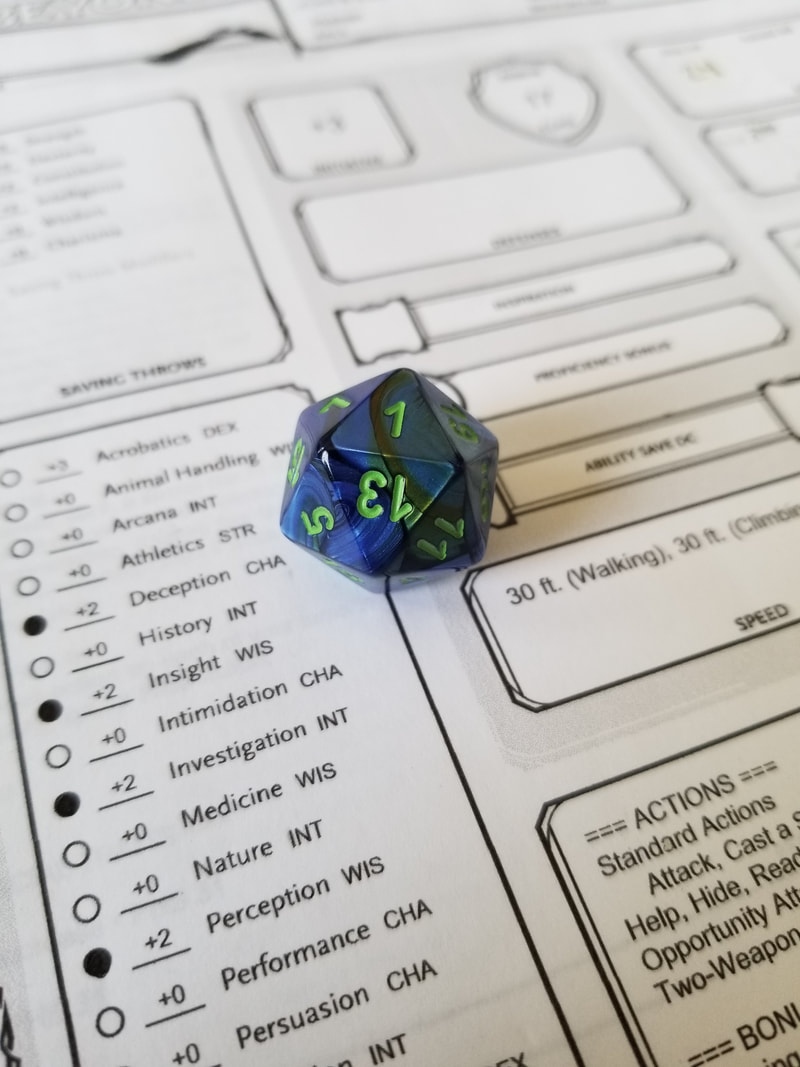
Bring Your Dice To Work Day:
Wednesday lunch hour. Boss fight. We have a plan. We draw out the boss. We attack without mercy. The foot soldiers fall. The boss gets hammered. We grab the box. Success! But wait! I am playing the rogue and I need to stealth away. No worries, I say. I have a +7 on Stealth. Easy peasy. Rolled a 1.
That is the beauty of dice rolls in an RPG. There is no reason why we shouldn’t succeed based on our plan and coordination. We have the numbers and skills to overpower, plus we have the ability to trick and deceive, to intimidate and confuse. We will prevail. The failed dice roll probably won’t change the ultimate outcome, but it is easy to argue that it make the outcome more memorable. If I would have said “oh hey, let’s say I slip and fall ‘cause that will add some serious suspense”, it would not have had any impact. Contrived emotion and scripted action sounds like a bad television show. Rolling a 1 in that moment makes for a wonderfully memorable experience. The heart-dropping feeling, the laughs from my friends after my muttered f-bomb, the jokes after how the fighter, the barbarian, and the cleric all succeeded buy my rogue failed. All that makes for a much better memory.
The memories are also accentuated by the random comments that stick with the party. We dragged an NPC out from under a gelatinous cube a few sessions ago. His legs were covered by the cube, and he took some pretty significant damage (3d6). We weren’t sure if he would live but we used a healing spell on him and ultimately gained an ally. He was unconscious for a while so we couldn’t get a name, so there was an offhand comment about “Legless Jack”. The name stuck. The DM could have had a name for him, but we as players never asked for it since he will forever be Legless Jack to us.
Here’s to more memories coming from the shared storytelling medium of an RPG. \
New Beers:
Only one new beer this week. The Surround Sound DIPA from Collective Arts was another fine beer from the brewery that is steadily becoming my favorite. (Sorry Blindman and Alley Kat!) This was a hazy, citrusy beer with a nice bit of pine, and great balance all around. Submitting that to Untappd earned me the I Believe in IPA (Level 23) badge.

New Words:
A few new words this week, and one repeat offender.
abjure
[ ab-joo r, -jur ]
VERB.
- to renounce, repudiate, or retract, especially with formal solemnity; recant
lacuna
[ləˈk(y)o͞onə]
NOUN
- an unfilled space or interval; a gap.
mordant
[ˈmôrdnt]
ADJECTIVE
- (especially of humor) having or showing a sharp or critical quality; biting.\
NOUN
- a substance, typically an inorganic oxide, that combines with a dye or stain and thereby fixes it in a material.
VERB
- impregnate or treat (a fabric) with a mordant.
eusocial
[yo͞oˈsōSHəl]
ADJECTIVE
zoology
- (of an animal species, especially an insect) showing an advanced level of social organization, in which a single female or caste produces the offspring and nonreproductive individuals cooperate in caring for the young.